
AI-era slang dictionary

AI Engineering & Debugging Slang

Vibe
debugging

Vibe debugging is tossing error messages into an AI chat and applying generated diffs until a symptom disappears, without finding the root cause.

uncaught error -> paste trace (attempt 8) -> accept diff -> repeat
First recorded: 2025Habitat: terminal traces, agent chats, mystery regressionsStatus: symptom-swappingUpdated:
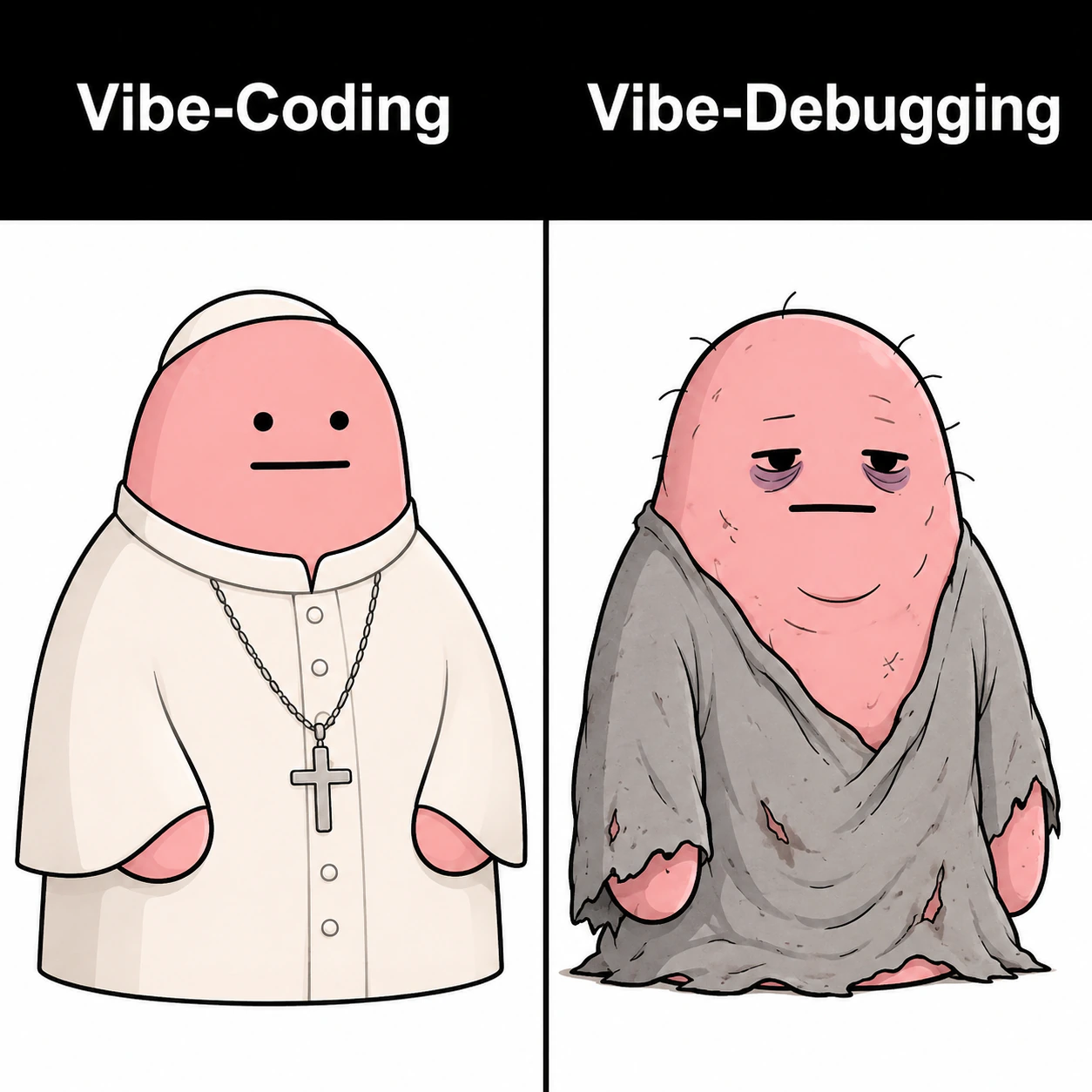
Vibe-coding vs vibe-debugging: the deadpan blob in pristine papal robes next to the same blob in torn rags with bags under its eyes

The short version

Silencing a stack trace is not fixing a bug.

Tossing error messages into an AI chat and applying diffs until the error stops showing up hides broken state rather than solving the underlying cause.

What it actually means

Vibe debugging describes troubleshooting software by tossing raw error messages into an AI chat and blindly accepting whatever diffs come back until the immediate crash message disappears. It skips the core steps of engineering diagnosis: isolating a deterministic reproduction, inspecting runtime state, forming a causal hypothesis, and verifying the fix with a test.

The term is not an attack on AI-assisted engineering. Using a model to explain an unfamiliar stack trace, suggest plausible failure modes, or draft a regression test is disciplined work. Vibe debugging also differs fundamentally from rubber-duck debugging: explaining code to a rubber duck forces a human to clarify their own mental model, whereas vibe debugging outsources reasoning entirely to an external generator.

Cultural Context & Sighting

The prompt in the wild.

“A developer encounters an unhandled exception, copies the raw terminal trace into a prompt, accepts whatever diff the model returns, and repeats the loop six times until the console error goes quiet—only for a silent data corruption bug to surface three modules downstream.”

Failure modes of the patch loop

Because language models optimize for plausible local edits rather than global system invariants, vibe debugging routinely produces destructive failure patterns. A model might insert a defensive null guard that merely conceals missing state, wrap a critical operation in an empty catch block that defers failure downstream, or propose escalating full-file rewrites that silently discard earlier bug fixes.
Another recurring trap is the false victory: a model confidently announces that an issue is resolved simply because the provided error string would no longer trigger on that exact line, even though no test was executed and the underlying invariant remains broken.
The phrase emerged naturally after Andrej Karpathy popularized “vibe coding” in February 2025 as natural-language-driven development. In March 2025, Analytics India Magazine documented “vibe debugging” as the inevitable bottleneck when generated prototypes met edge cases. Later in 2025, a qualitative study by Microsoft Research (arXiv:2509.12491) detailed how developers struggle with significant review and debugging overhead when trying to diagnose code they did not mentally author.

Useful Practical Framing

How to escape the vibe-debugging loop

Moving from conversational symptom-swapping to disciplined causal investigation.

01 / Deterministic reproduction

Write a minimal failing test or reproduction script before touching any code or opening a prompt. You cannot verify a fix if you cannot reliably trigger the bug.

02 / Inspect state & demand hypotheses

Inspect runtime variables and trace data. Ask the model to explain the causal sequence that led to the invalid state, and reject diffs that only add null guards or empty catches.

03 / Verify invariants & regressions

Review diffs line-by-line to ensure they preserve architectural boundaries and do not move crashes downstream. Run the reproduction check to confirm root-cause resolution.

Tiny origin story

How Vibe debugging entered the chat.

Evolution from early observations to current AI-era usage.

  1. Feb 2025

    Andrej Karpathy coins “vibe coding,” describing a workflow where builders steer AI with conversational prompts and accept diffs without line-by-line inspection.

  2. Mar 2025

    Analytics India Magazine documents “vibe debugging” as builders hit compounding regressions from unverified conversational patches.

  3. Late 2025

    Microsoft Research (arXiv:2509.12491) publishes qualitative findings on the cognitive and review burden of debugging unfamiliar AI-generated logic.

  4. Now

    “Vibe debugging” serves as standard developer shorthand for conversational symptom-swapping that masks errors instead of fixing root causes.

Keep reading

Same ecosystem, different specimen.

All field notes

What to say back

Isolate a deterministic reproduction and inspect the runtime state before generating another patch. Require the model to provide a clear causal hypothesis, verify every diff against system invariants, and reject any change that merely silences the error.

Refer the speaker