
AI slang & engineering
Context stuffing.
What is context stuffing?
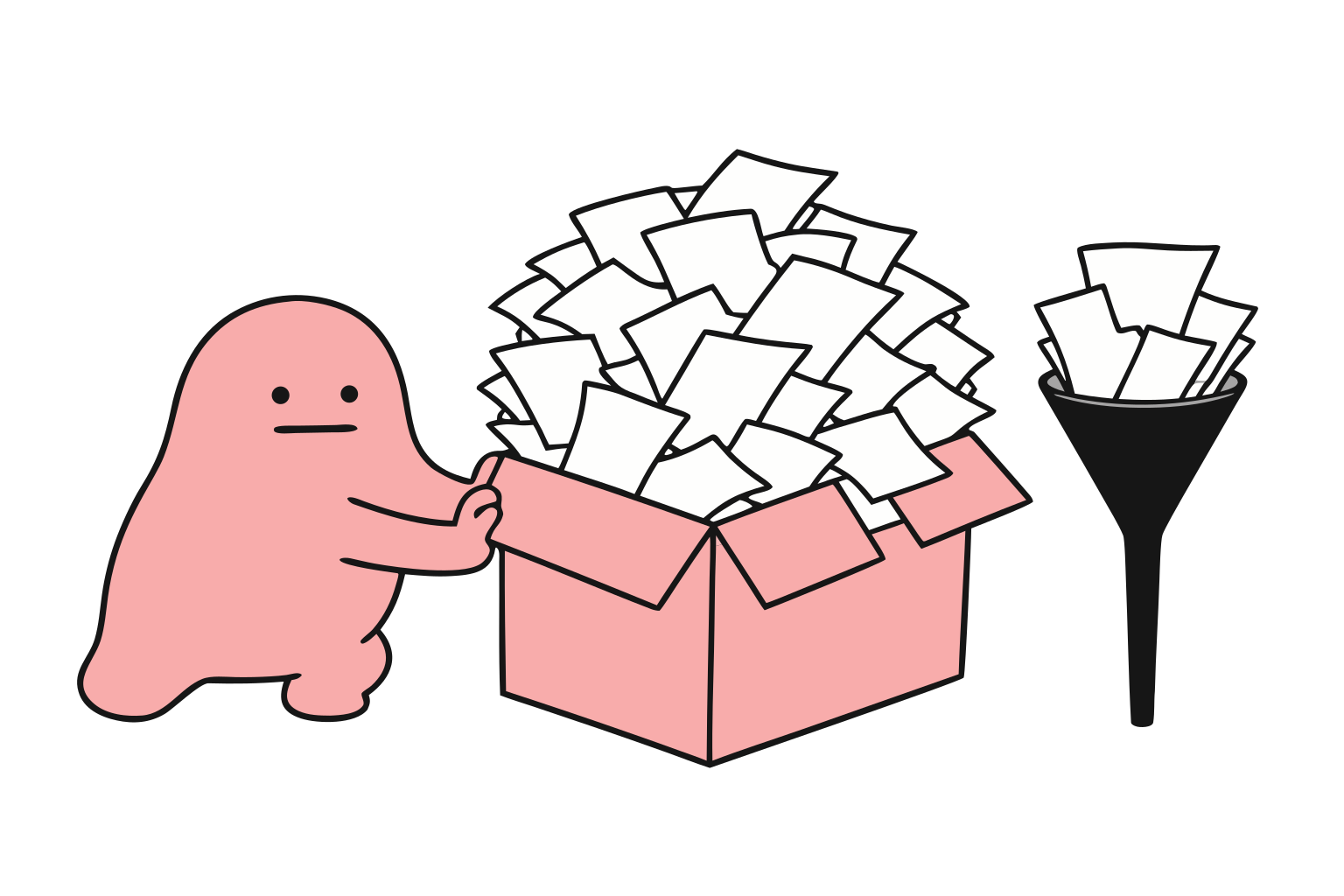
Context stuffing is putting a large, mostly unfiltered pile of documents, history, code, or tool output into an AI prompt and expecting the model to find what matters.
When context windows expanded to millions of tokens, stuffing became the default path of least resistance: developers dump entire files, code trees, and raw logs into the window instead of building selective retrieval.
01 · Meaning
What the term describes
Context stuffing is the operational decision to load massive, uncurated data dumps into a prompt rather than isolating the specific facts required for a decision.
As frontier models expanded active prompt capacities from thousands of tokens to several million, developer habits adapted quickly. Instead of investing in precise chunking pipelines, structured query filters, or relevance ranking, teams began piping whole documentation sites, complete git repositories, endless conversation histories, and raw terminal feeds directly into prompt payloads.
02 · Drivers and side effects
Why teams stuff prompts and what breaks
Dumping raw material into prompts removes the friction of building search infrastructure, but carrying large distractor loads extracts a predictable toll on accuracy, latency, and cost.
The distractor tax
Feeding thousands of unranked tokens into a model does not yield uniform attention across the document. In their "Lost in the Middle" paper, Liu et al. documented that retrieval accuracy follows a U-shaped curve, where information located in the center of long contexts suffers worse recall than text near the start or end. Surrounding relevant facts with irrelevant distractor documents degraded performance across every tested architecture.
Measured performance decay
Chroma's 2025 research across 18 models found that task performance consistently degraded as total token counts grew, with semantically similar distractors causing the sharpest drops. In one LangChain benchmark testing high-cardinality value matching, GPT-4 dropped to 26% accuracy when 10,000 candidate values were stuffed into the prompt, while a selective similarity method achieved 83%.
Compounding latency and token waste
Every stuffed token adds linear time-to-first-token delay and inflates inference spend on every generation step. In continuous agent loops where an assistant makes dozens of sequential calls, paying that distractor tax on every turn slows feedback loops and burns budgets rapidly.
03 · In practice
Where context stuffing appears
In coding agents, context stuffing happens when an automated assistant appends every raw shell output, entire directory tree, unpruned test trace, and multi-thousand-line source file into the persistent conversation history instead of inspecting targeted code slices.
In document search systems, it occurs when an application injects forty full PDF documents into a prompt to answer a specific query about one policy clause, leading the model to hallucinate or miss the target text while quoting neighboring paragraphs.
In multi-step assistants, it surfaces when chat sessions accumulate weeks of historical requests, stale facts, and obsolete scratchpads, forcing the model to arbitrate between outdated context and current goals.
04 · Distinctions
What context stuffing is not
Not context rot
Context stuffing is the prompt design choice: pouring large, unfiltered text piles into the request. Context rot is the subsequent performance degradation and confusion that can develop over time from carrying that sediment.
Not the lost-in-the-middle effect
Lost-in-the-middle is a positional failure pattern where facts placed in the interior of a long prompt get overlooked. Context stuffing is the broader practice of loading excessive material regardless of where individual facts land.
Not retrieval-augmented generation
Retrieval pipelines query an index to surface a concise set of relevant passages before building the prompt. While retrieval can sometimes miss a necessary excerpt, it filters source material upstream rather than dumping entire databases into the context.
When full-document prompts make sense
Providing a whole document is sensible when the text is short, tightly related, and requires holistic synthesis across every section, such as summarizing a single contract or refactoring a self-contained source module.
05 · Practical guidance
How to build cleaner context
Treat prompt context as an active workbench for the next decision, never as a general-purpose filing cabinet.
Adopt just-in-time context
Anthropic's 2025 context engineering guidance recommends loading information dynamically on demand rather than bulk-loading whole codebases upfront. Provide agents with targeted search tools and file inspection utilities so they pull only the specific lines needed for the immediate step.
Prune execution logs and transcripts
Strip verbose stack traces, intermediate failed hypotheses, and routine command outputs once key findings are confirmed. Keep the verified fact in the working context; drop the raw terminal echo.
Isolate discovery from synthesis
Separate complex research workflows into distinct phases. Use focused worker prompts to locate candidate information, then pass only the extracted, high-relevance findings to the final decision step.
Related field notes
All field notesMeat Proxy
Habitat: Slack threads, pull requests, group chats
Who is JSON?
Habitat: full-access prompts
What is localhost?
Habitat: demo links and deploy chats
Make no mistake!
Habitat: Cursor prompts, agent chats, vibe-coding memes
Great question!
Habitat: chat windows, AI demos, support drafts
Dead Internet Theory
Habitat: comment sections, feeds, AI-slop discourse
Dangerously skip permissions
Habitat: coding-agent CLIs, YOLO aliases, unattended runs
Slopsquatting
Habitat: package registries, agent workflows, supply-chain research
AI washing
Habitat: pitch decks, enterprise sales demos, press releases
Slop coding
Habitat: unreviewed pull requests, agent loops, parallel utility directories
Byte for byte.
Habitat: agent completion notes, visual rebuilds, confident handoffs
Say the word and…
Habitat: chatbot closings, agent handoffs, one-more-thing prompts
Vibe debugging
Habitat: terminal traces, agent chats, mystery regressions
Context Rot
Habitat: long chats, coding agents, overloaded prompts
Cognitive Debt
Habitat: AI-assisted work, generated code nobody can explain
Jealousy-Driven Development
Habitat: AI coding assistants, competitive prompts, code review
Tokenmaxxing
Habitat: AI subscription capacity, reset windows, overnight agent work